No tax on overtime calculator.
Free no tax on overtime calculator for the 2025 to 2028 OBBBA deduction. See your exact deduction and the real dollars it saves, computed the way the IRS Schedule 1-A form does it.
IRC §225 · TAX YEARS 2025-2028
Your result
TAX YEAR 2026
Heads-up: this tax year uses projected figures; the IRS has not yet published its official inflation adjustments.
Married filing separately doesn't qualify.
The law (IRC §225(e)) requires married taxpayers to file jointly to claim this deduction. Switch to "Married filing jointly" to see your household's number.
Federal tax saved
$650
≈ deduction × your bracket
Deduction
$5,000
Sch. 1-A, line 21
Per paycheck
$25.00
savings ÷ 26 paychecks
Marginal rate
22%
top federal bracket
Where your overtime pay goes
$15,000 total OT pay
Taxed as usual $10,000
Deducted $5,000
Lost to cap / phase-out $0
We only know your overtime so far, so the savings estimate assumes no other income. Add Regular wages this year in the form (or type your MAGI directly) to see your real savings.
Your premium of exceeds the cap, the excess isn't deductible.
Income phase-out reduced your deduction by .
At MAGI, this deduction is fully phased out.
The IRS hasn't clarified whether qualifying surviving spouses get the $25,000 joint cap. We conservatively apply $12,500 until official guidance lands.
For 2026, paychecks don't change automatically: you get this back as a refund at filing, or update your W-4 to see it during the year. How to claim →
Income phase-out
Full deduction below $150,000
Line-by-line worksheet (matches IRS Schedule 1-A, Part III)
| Line | Item | Amount |
|---|---|---|
| 14c | Qualified overtime premium (0.5× portion only) | $5,000 |
| 15 | Maximum allowed (your filing status) | $12,500 |
| 16 | Smaller of the two | $5,000 |
| 17-18 | MAGI over threshold | $0 |
| 19-20 | Phase-out reduction ($100 per full $1,000 over) | $0 |
| 21 | Qualified overtime deduction | $5,000 |
| - | Estimated federal income tax saved | $650 |
Heads-up: Social Security & Medicare (7.65% ≈ $1,148 on your OT pay) still apply. This deduction only reduces federal income tax, and state income tax may also still apply. Check your state.
Estimates only, not tax advice. Assumes W-2 wages and the standard deduction. Methodology & sources
The six rules that decide your number.
Premium only
Only the extra "half" of time-and-a-half is deductible. $30/hr overtime on a $20/hr wage → $10/hr qualifies. Shortcut: total 1.5× pay ÷ 3.
Caps
$12,500 per return. $25,000 on a joint return. Same caps every year, 2025 through 2028, not adjusted for inflation.
Income phase-out
Minus $100 for each full $1,000 of MAGI above $150,000 ($300,000 joint). The rounding goes in your favor. $150,900 income means zero reduction.
Federal-law overtime only
FLSA overtime (over 40 hrs/week) qualifies. California daily OT, contract OT, and the extra pay above 1.5× do not.
FICA still applies
Social Security and Medicare (7.65%) still come out of every overtime dollar, and most states still tax it. This is a federal income tax deduction.
W-2 workers, filing jointly if married
You need FLSA-covered W-2 overtime, a valid SSN, and (if married) a joint return. Married filing separately gets $0.
Verified against 26 USC §225, IRS Notice 2025-69, and the 2025 Schedule 1-A. See methodology
How the calculator gets your number.
The math mirrors Part III of IRS Schedule 1-A, the actual form you'll file.
- 1
Isolate the qualified premium
From hours: rate × 0.5 × federal OT hours. From pay stubs: time-and-a-half total ÷ 3, double-time total ÷ 4. From a W-2: the reported amount is used as-is.
- 2
Apply the cap
The smaller of your premium or $12,500 ($25,000 joint) moves forward.
- 3
Apply the income phase-out
MAGI over $150,000 ($300,000 joint)? Divide the excess by $1,000, round DOWN to a whole number, multiply by $100, and subtract. That round-down is straight from Schedule 1-A line 19. Some calculators get it wrong.
- 4
That's your deduction
It goes on Schedule 1-A line 21 and flows to Form 1040. It stacks with your standard deduction.
- 5
Convert to real dollars saved
We run your taxable income through the actual federal brackets for your year and filing status, with and without the deduction. The difference is your savings, including when the deduction straddles two brackets.
ONE OVERTIME HOUR · $20/HR REGULAR RATE
1.5× PAY
÷ 3
$15,000 of OT pay → $5,000 qualified
2× PAY
÷ 4
$20,000 of 2× pay → $5,000 qualified
Shortcuts straight from IRS Notice 2025-69, Examples 2 and 4. The full guide covers every pay-stub method for 2025.
What counts as qualified overtime, and what doesn't.
The law only covers overtime required by section 7 of the Fair Labor Standards Act, the federal over-40-hours-a-week rule. That single sentence disqualifies more pay than most people expect.
Qualifies
- The 0.5× premium on hours over 40/week (W-2 employees)
- The 0.5× slice inside double-time pay for federal OT hours
- Police & fire overtime on 207(k) work periods
- Hospital "8 and 80" schedule overtime (207(j))
- Public-sector comp time cashed out as wages, in the year paid
- Salaried non-exempt workers' FLSA overtime
Doesn't qualify
- The 1.0× base portion of every overtime hour (always taxable)
- State-only overtime, e.g. California daily OT in an under-40 week
- Anything above 1.5× (the extra 0.5× in double-time)
- Contract or union overtime beyond what federal law requires
- Exempt salaried employees' extra hours (no FLSA OT exists)
- 1099 contractor pay, and tips (tips have their own deduction)
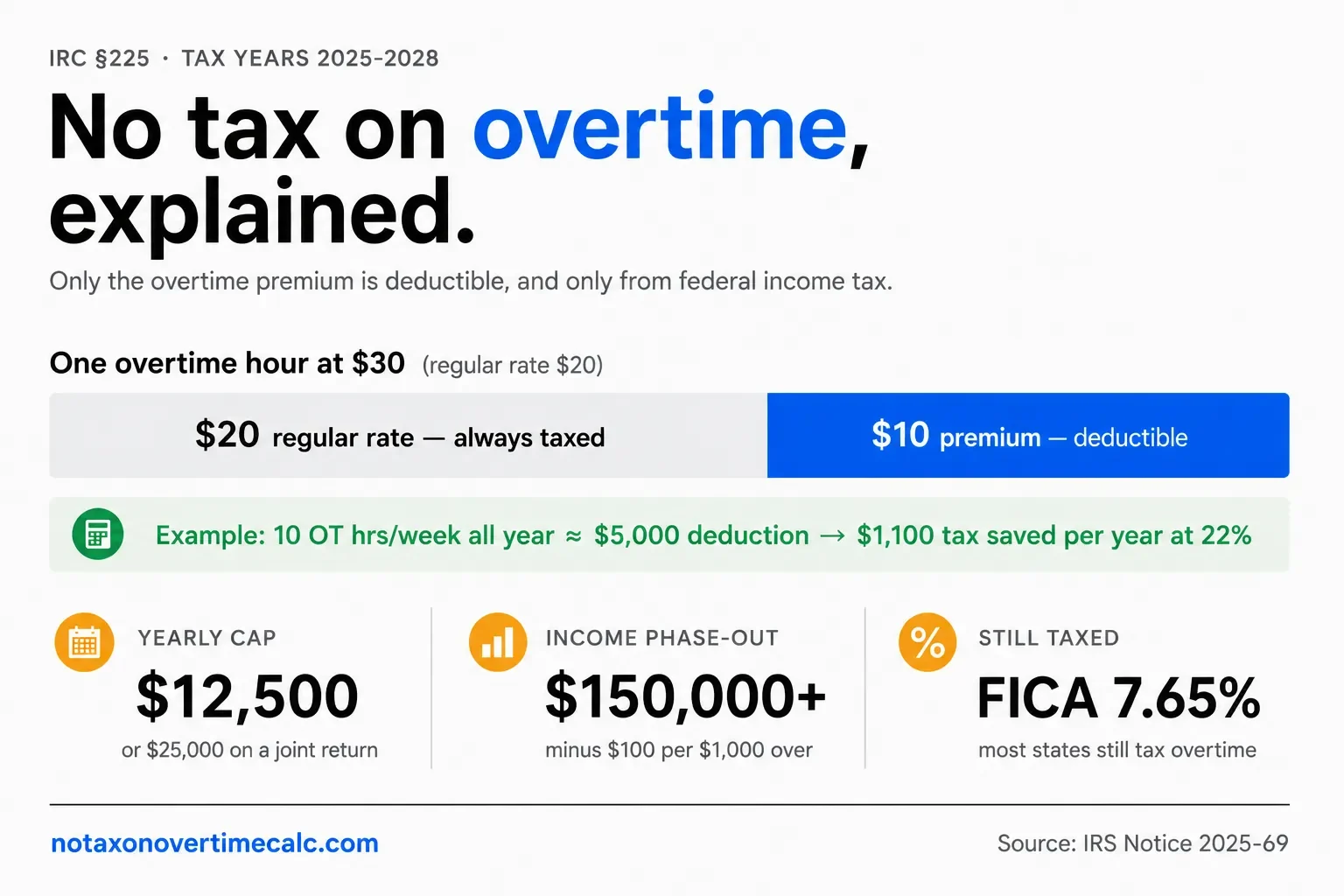
Deep dive with pay-stub methods for 2025: how the overtime deduction works.
Worked examples. Real scenarios, real math.
All figures use 2026 rules and assume the standard deduction. Run your own numbers in the calculator above.
Warehouse worker
$22/hr · 10 OT hrs/wk, 50 weeks
Single, MAGI ≈ $60,500
Premium $5,500
Deduction $5,500
$660
federal tax saved
ER nurse
$48/hr · 12-hour shifts, about 8 OT hrs/wk, 48 weeks
Head of household, MAGI ≈ $120,000
Premium $9,216
Deduction $9,216
$2,028
federal tax saved
Police officer
207(k) schedule · $15,000 total OT pay
Single, MAGI ≈ $98,000. Premium = $15,000 ÷ 3.
Premium $5,000
Deduction $5,000
$1,100
federal tax saved
Factory couple
$30,000 combined OT premium
Married filing jointly, MAGI $340,500. Capped at $25,000, then a $4,000 phase-out.
Premium $30,000
Deduction $21,000
$5,040
federal tax saved
High earner in the phase-out
$12,500 premium · $200,000 MAGI, single
The phase-out subtracts $5,000 but does not erase the deduction. Some calculators wrongly show $0 here. The Schedule 1-A worksheet allows $7,500.
Deduction $7,500
$1,800
federal tax saved
Why is my paycheck the same? Withholding vs. refund.
This is the single most-asked question about the law. The deduction is real, but it is not automatic in your paycheck:
2025
The IRS didn't change withholding tables mid-year, so 2025 paychecks looked identical all year. The entire benefit arrives on your 2025 return (filed in early 2026) as a bigger refund or smaller bill.
2026-2028
Employers still withhold normally by default. But the 2026 Form W-4 deductions worksheet now has a line for qualified overtime: submit an updated W-4 and your per-paycheck withholding drops during the year instead of waiting for filing season.
Step-by-step instructions: how to claim the overtime deduction.
About this no tax on overtime calculator.
What the calculator does
This no tax on overtime calculator estimates how much of your overtime pay escapes federal income tax under the qualified overtime deduction, then converts that deduction into the dollars you actually keep. Enter your hourly rate and weekly overtime hours, or the totals from your pay stubs, or the amount your employer reported on your W-2. Results appear instantly: your deduction, your estimated federal tax saved, and what that works out to per paycheck. Nothing you type is sent anywhere, and there is no sign-up.
Where the law came from
The deduction was created by the One Big Beautiful Bill Act, the tax package President Trump signed on July 4, 2025. The White House had campaigned on the phrase "no tax on overtime," and what Congress enacted is a temporary, capped deduction under new Internal Revenue Code section 225 rather than a full exemption. It applies to tax years 2025, 2026, 2027, and 2028, then expires unless Congress extends it. This calculator covers all four years, and clearly labels 2027 and 2028 as projections because the IRS has not published inflation adjustments for those years yet.
How to calculate no tax on overtime
Three rules decide your number, and this tool applies each one the way the IRS Schedule 1-A worksheet does. First, only the premium portion counts: the extra "half" in time-and-a-half, not the full 1.5×. If your regular rate is $20 and overtime pays $30, only $10 an hour qualifies. From a pay stub, divide your total time-and-a-half pay by three. Second, the deduction is capped at $12,500, or $25,000 on a joint return. Third, it shrinks by $100 for every full $1,000 of modified adjusted gross income above $150,000 ($300,000 joint), reaching zero at $275,000 and $550,000. Many tools skip the phase-out or round it the wrong way. Ours follows line 19 of the real form, which rounds down in your favour.
How this compares to the IRS and TurboTax tools
The IRS publishes the rules but no calculator, so working out your figure from IRS pages means reading a fact sheet and doing the arithmetic yourself. TurboTax offers a widget that reports a qualified overtime amount but has no income field, so it cannot apply the phase-out and never tells you what you save. This calculator does both, shows the line-by-line worksheet behind every figure, and prints it so you can file with it beside you.
Bigger refund now, or bigger paychecks
For 2025 the IRS never updated withholding tables, so paychecks looked the same all year and the benefit arrives as a larger refund or a smaller balance due when you file. From 2026 the Form W-4 deductions worksheet includes a line for qualified overtime, so you can lower withholding during the year instead of waiting. The calculator shows both views, including the per-paycheck value of your deduction. Either way it is money you were not budgeting for, so it is worth deciding where it goes: if you are putting it toward retirement, our Coast FIRE calculator shows what a lump sum invested today is worth by the time you stop saving.
Your state still matters
This deduction is federal. Because it sits below adjusted gross income on your return, most states never see it. Overtime in Texas and Florida is untouched either way, since neither state taxes wage income. California taxes every overtime dollar at the state level and does not recognise the federal deduction, New York passed a tips-only break instead, and Pennsylvania taxes overtime under its flat rate. Alabama runs its own smaller $1,000 deduction, and six states pass the federal one straight through. Pick your state in the calculator and it tells you exactly where you stand.
Built on primary sources
Every figure here comes from the statute, IRS Notice 2025-69, the 2025 Schedule 1-A, and the official bracket revenue procedures, all cited at the bottom of this page. The maths is covered by an automated test suite checked against the IRS worked examples, so a change that breaks an example never reaches you. When the IRS or a state changes something, we date it on the law and guidance updates page. This is a free estimate for education, not tax advice.
Frequently asked questions.
Twenty real questions, answered from the statute and IRS guidance. Longer walkthroughs live in the guides and state pages.
Is this the Trump "no tax on overtime" calculator?
Yes, this calculator models the deduction created by the One Big Beautiful Bill Act, the tax law President Trump signed on July 4, 2025 after campaigning on "no tax on overtime." The White House proposal became a capped, temporary deduction under Internal Revenue Code section 225 rather than a full exemption, and this tool applies the version that was actually enacted.
Does the IRS have an official no tax on overtime calculator?
No. The IRS publishes the rules, a Q&A fact sheet, and the Schedule 1-A form, but it does not offer a calculator that works out your deduction from your hourly rate or pay stubs. This free calculator fills that gap by following the same IRS worksheet, and every figure it uses is cited from IRS sources.
How is this different from the TurboTax no tax on overtime calculator?
The TurboTax widget reports a qualified overtime figure but has no income field, so it cannot apply the MAGI phase-out and never shows the dollars you save. This calculator asks for income, applies the phase-out exactly as Schedule 1-A line 19 does, converts your deduction into estimated federal tax saved at your bracket, and shows the full line-by-line worksheet behind the number.
How do I calculate my no tax on overtime deduction by hand?
Take your total time-and-a-half pay for the year and divide it by 3 (divide double-time pay by 4). Cap the result at $12,500, or $25,000 on a joint return. Then subtract $100 for every full $1,000 your modified adjusted gross income exceeds $150,000 ($300,000 joint). What remains is your deduction. Multiply it by your federal tax bracket to figure your savings. Full worked walkthrough.
How much will no tax on overtime increase my tax refund?
Your refund grows by roughly your deduction multiplied by your marginal tax rate. A $5,000 deduction is worth about $600 at the 12% bracket, $1,100 at 22%, or $1,200 at 24%. It is a refund increase rather than a bigger paycheck because 2025 withholding tables were never updated for this deduction, so the tax you already paid comes back when you file.
Does no tax on overtime apply in Texas, Florida, Pennsylvania, and California?
The deduction is federal, so workers in every state can claim it. What changes is the state side: Texas and Florida have no state income tax, so overtime is untouched there either way. Pennsylvania taxes overtime under its flat rate and California taxes it at rates up to 13.3%, and neither state recognises the federal deduction. See all 50 states.
How does the no tax on overtime deduction work?
It is a federal income tax deduction, not a full exemption. For tax years 2025 through 2028, you can deduct the premium portion of your federal-law overtime pay (the extra "half" in time-and-a-half) up to $12,500 ($25,000 on a joint return). Taxes are still withheld from your paychecks; the benefit shows up when you file your return on Schedule 1-A.
How much of my overtime is tax-free?
Only the overtime premium, the extra 0.5× above your regular rate. If you earn $20/hour and get $30/hour for overtime, only the $10 premium per hour is deductible. Quick shortcut from a pay stub: total time-and-a-half pay ÷ 3.
What is the maximum overtime deduction?
Up to $12,500 per year for single filers and heads of household, or $25,000 on a joint return. The cap is per tax return, not per person, and it is the same for every year from 2025 through 2028 (it is not inflation-adjusted). For qualifying surviving spouses the IRS has not yet clarified which cap applies, our calculator conservatively uses $12,500.
Is there an income limit on the overtime deduction?
Yes. The deduction shrinks by $100 for every full $1,000 of modified adjusted gross income (MAGI) above $150,000 ($300,000 on a joint return). At the maximum deduction, it reaches zero at $275,000 single / $550,000 joint. MAGI includes your overtime pay.
Do I still pay Social Security and Medicare tax on overtime?
Yes. The 7.65% employee share of FICA (Social Security + Medicare) still comes out of every overtime dollar. This deduction only reduces your federal income tax. "No tax on overtime" is a nickname, not a literal description.
Will my paycheck get bigger, or do I wait for my refund?
For 2025, IRS withholding tables were not changed, so paychecks stayed the same all year and the benefit arrives as a bigger refund (or smaller balance due) at filing. From 2026, you can update Form W-4 (Step 4(b)) to reduce withholding during the year, otherwise you still get it at filing.
Do salaried employees qualify?
Only if they are non-exempt under the Fair Labor Standards Act and actually receive FLSA-required overtime. Exempt salaried employees (most managers, professionals, and administrators paid on a salary basis above the exemption threshold) receive no FLSA overtime, so nothing qualifies.
Do 1099 contractors or self-employed workers qualify?
Generally no. Independent contractors are not entitled to FLSA overtime, so they have no qualified overtime compensation. A rare exception exists for workers who are non-employees for tax purposes but legally employees under the FLSA. IRS Notice 2025-69 calls this "possible (but not common)".
Can I claim it if I take the standard deduction?
Yes. This deduction is available whether or not you itemize. It stacks on top of your standard deduction and reduces taxable income (it does not reduce AGI).
How do I claim the overtime deduction on my tax return?
File Schedule 1-A (Additional Deductions) with your Form 1040, 1040-SR, or 1040-NR. Part III walks through the overtime deduction: enter your qualified overtime, apply the cap, apply the income phase-out, and carry the result to Form 1040. A valid Social Security number is required, and married taxpayers must file jointly.
Where do I find my qualified overtime amount on my W-2?
For 2025, employers were not required to update W-2s, look for box 14 or a separate statement, or compute it yourself (total time-and-a-half pay ÷ 3 is an IRS-approved method). From tax year 2026, employers must report it on the W-2 (box 12, code TT, per IRS reporting guidance).
Does double-time pay qualify?
Only partially. Federal law requires only time-and-a-half, so even when you are paid 2×, only the 0.5× slice above your regular rate is qualified, the IRS shortcut is total double-time pay ÷ 4. The extra pay above 1.5× never qualifies.
Does California daily overtime count?
Not for the federal deduction. Only overtime required by federal law (over 40 hours in a workweek) qualifies. California's daily overtime (over 8 hours in a day within an under-40-hour week) is required by state law, not the FLSA, so it does not qualify. See the California guide.
Can I claim it if I'm married filing separately?
No. The law explicitly requires married taxpayers to file jointly to claim this deduction (IRC §225(e)). Married filing separately returns get $0.
Do nurses, police officers, and firefighters qualify?
Yes, if they are FLSA non-exempt and receive FLSA-required overtime. Special federal overtime schedules still count: police and fire under 29 USC 207(k) work periods, hospital workers under 8-and-80 agreements (207(j)), and public-sector comp time cashed out as wages (207(o), counted in the year paid).
Is overtime taxed at a higher rate?
No, that is a myth. Overtime is taxed at the same rates as regular wages. Bigger paychecks can trigger more withholding up front, which is why overtime checks feel more heavily taxed, but it evens out on your return. Full explanation.
Can I claim both the tips deduction and the overtime deduction?
Yes. "No tax on tips" (up to $25,000) and "no tax on overtime" ($12,500/$25,000) are separate deductions with separate caps, both claimed on Schedule 1-A for 2025-2028. A tipped worker with qualifying overtime can claim both, but the same dollars can't count as both a tip and overtime.
When does no tax on overtime end?
It applies to tax years 2025 through 2028 and expires after 2028 unless Congress extends it. It took effect retroactively to January 1, 2025 when the One Big Beautiful Bill Act was signed on July 4, 2025.
Does the deduction lower my AGI or affect other credits?
No. It reduces taxable income, not adjusted gross income. AGI-based items (IRA limits, ACA premium credits, EITC, even this deduction's own MAGI phase-out) are calculated as if the deduction didn't exist.
Do state income taxes still apply to overtime?
Usually yes. The deduction sits below AGI on the federal return, so most states (which start from federal AGI) never see it. A minority of states that start from federal taxable income may inherit it. Check your state.
Sources
- 26 U.S. Code §225: qualified overtime compensation
- IRS Notice 2025-69: tips & overtime deduction guidance
- IRS Schedule 1-A (Form 1040): Additional Deductions
- IRS: what to know about the overtime deduction
- IRS FS-2026-01: Q&A on qualified overtime
- IRS Publication 15-T (2026): withholding methods
This site is an independent educational tool and is not affiliated with the IRS. Figures are estimates based on the sources above; your actual tax outcome depends on your full return. Not tax advice. Consult a qualified professional. Last reviewed: August 2026.