GUIDE · UPDATED AUGUST 2026
How the no tax on overtime deduction works.
The One Big Beautiful Bill Act created a federal deduction for overtime, but the name oversells it. Here is exactly what IRC §225 does, what pay qualifies, and how to compute your number from a pay stub, with every rule traced to the statute or IRS guidance.
It's a deduction, your overtime is not "tax-free."
Between 2025 and 2028, you can deduct part of your overtime pay from your federal taxable income. Three things that surprise people:
- •Your paycheck doesn't change by default. Withholding works like before; the benefit arrives when you file (or after you update your W-4 from 2026 on).
- •FICA still applies. Social Security and Medicare (7.65%) come out of every overtime dollar regardless.
- •Most states still tax it. The deduction sits below AGI, so most state returns never see it, check your state.
Who qualifies.
- ✓You're a W-2 employee covered by the Fair Labor Standards Act and non-exempt (entitled to overtime).
- ✓You received overtime required by federal law, over 40 hours in a workweek (or the special federal schedules for police, fire, and hospitals).
- ✓You have a valid Social Security number, and if married, you file jointly.
Not covered: exempt salaried employees (no FLSA overtime exists for them), independent contractors, and (for their overtime) workers whose overtime comes only from state law or a contract rather than the FLSA.
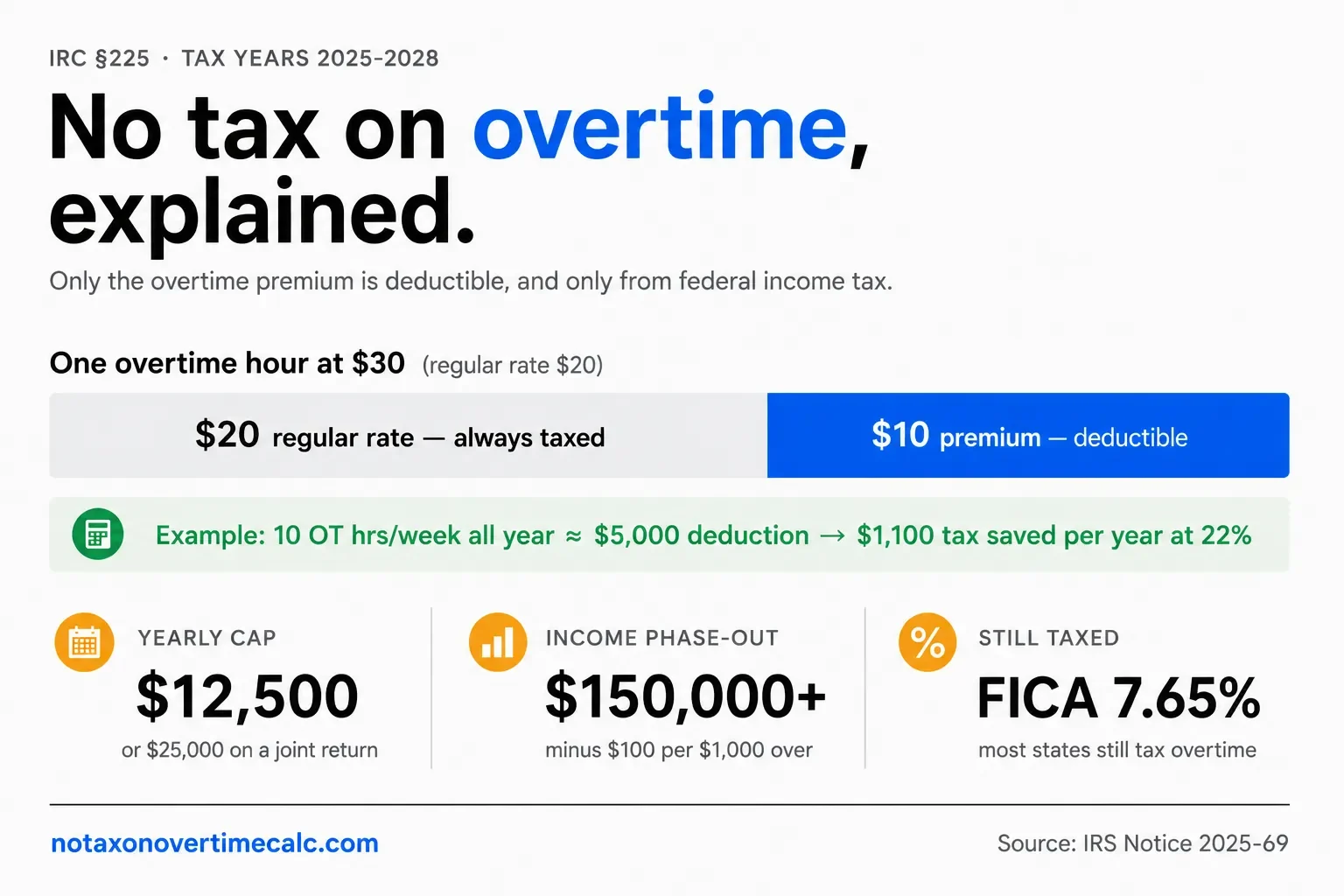
Only the premium counts: the "half" in time-and-a-half.
An overtime hour has two slices. Say you earn $20/hour and your overtime rate is $30/hour:
Only that $10 premium slice is "qualified overtime compensation" under IRC §225(c)(1), the pay required by FLSA §7 in excess of your regular rate. That's why the quick math from a pay stub is:
TIME-AND-A-HALF (1.5×)
total ÷ 3 = qualified
$15,000 of overtime pay → $5,000 qualified (IRS Notice 2025-69, Example 2).
DOUBLE-TIME (2×)
total ÷ 4 = qualified
$20,000 of double-time pay → $5,000 qualified, the extra above 1.5× never qualifies (Example 4).
One subtlety: your FLSA "regular rate" isn't just your base wage, nondiscretionary bonuses and shift differentials increase it, which increases the premium you were owed and can increase your deduction. See the FAQ below.
Finding your 2025 number, the IRS-approved methods.
2025 W-2s were not required to show qualified overtime (that starts with 2026 W-2s and box 12 code TT). For 2025 returns, IRS Notice 2025-69 blesses these approaches, you can even use different methods for different employers:
| Method | Your situation | What to do |
|---|---|---|
| A | Employer stated the premium (box 14, portal, or statement) | Use that number as-is. |
| B | Pay stubs show total time-and-a-half pay | Divide by 3. |
| C | Stubs separately state the 2× premium (the extra 1.0×) | Multiply by ½. |
| D | Stubs show total double-time pay | Divide by 4. |
| E | You got nondiscretionary bonuses on top of B or D | Adjust the estimate upward for the bonus effect on your regular rate. |
| F | No statements at all | Reconstruct: regular rate × 0.5 × hours over 40 per workweek. You may request info from your employer. |
| G | Special FLSA schedules (police/fire 207(k), hospital 8-and-80, comp time) | Same premium principle applied to those work periods. |
Keep the pay stubs or statements you relied on; standard recordkeeping rules (§6001) apply.
Then the cap and the income phase-out.
Once you have the qualified premium: cap it at $12,500 ($25,000 joint), then reduce it by $100 for each full $1,000 your MAGI exceeds $150,000 ($300,000 joint). The rounding is taxpayer-favorable, the official Schedule 1-A instruction literally says to round down ("decrease 1.5 to 1"). Full walkthrough with your own numbers: the calculator shows every line.
Police, firefighters, nurses, and comp time: special schedules count.
FLSA §7 isn't only the over-40 rule. Overtime required under its special provisions also qualifies: police and fire on 207(k) work periods (the IRS example: $15,000 of work-period overtime → $5,000 qualified), hospital and residential-care staff on 8-and-80 agreements (207(j)), and public-sector comp time when cashed out as wages (207(o)) - counted in the year paid.
What never qualifies.
- ✕The 1.0× base slice of every overtime hour, always taxable.
- ✕State-only overtime: California daily OT in an under-40 week, 7th-day premiums, farm or live-in schedules beyond the FLSA, California guide.
- ✕Contract or union overtime beyond what federal law requires, and everything above 1.5× in double-time.
- ✕Overtime of FLSA-exempt workers, including railroad employees and other §13(b)-exempt categories, whose overtime isn't FLSA-required.
- ✕Tips, they have their own separate deduction (up to $25,000), and the same dollars can't be both.
The clock: 2025 through 2028.
The deduction applies to tax years beginning after December 31, 2024 and ends after 2028 unless Congress extends it. It was signed July 4, 2025 and applied retroactively to January 1, 2025, which is why 2025 had the transition-year quirks above. We track changes on the updates page.
Questions people actually ask.
Do bonuses change how much of my overtime qualifies?
They can increase it. Nondiscretionary bonuses (production, attendance, shift differentials) raise your FLSA "regular rate," which raises the 0.5× premium your employer owed, and the qualified amount with it. IRS Notice 2025-69 method E lets you adjust the basic ÷3 estimate upward for these.
I worked overtime for two employers. Does each get its own cap?
No. The $12,500 / $25,000 cap applies per tax return. Add the qualified overtime from every employer together on Schedule 1-A, then apply one cap.
Does comp time count?
Public-sector comp time counts only when it is cashed out as wages, and it counts in the year it is paid, not the year the overtime was worked. Per the IRS example, a $4,500 comp-time cash-out yields $1,500 of qualified overtime (the 0.5× slice).
My last December 2025 workweek was paid in January 2026. Which year does it count for?
The year it was paid. 2026. IRS Notice 2025-69 confirms qualified overtime is counted when received, so a payroll period paid in January 2026 belongs on your 2026 return.
My employer won't tell me my qualified overtime amount. What can I do?
For 2025, the IRS allows any reasonable method: reconstruct it from pay stubs (time-and-a-half totals ÷ 3), or from your regular rate × 0.5 × overtime hours over 40 per workweek. You may also request the information from your employer. Keep your records, §6001 recordkeeping applies.
Sources
- 26 U.S. Code §225
- IRS Notice 2025-69 (methods A-G, worked examples)
- IRS FS-2026-01 Q&A
- U.S. DOL: FLSA overtime rules
Educational content, not tax advice. Reviewed against primary sources August 2026 by the NoTaxOnOvertimeCalc Team.